The Match of the Century
The isolated pawn, seen in Strategic Maps: isolated pawn, offers White various strategic possibilities. Among the most common plans, it can serve as a base for an attack on the King’s side, often through maneuvers with the Knight on e5 or even sacrifices to open lines and create initiative.
Another key idea is the d5 push, which, if played at the right moment, can free up piece activity and transform the static energy of the position into concrete dynamism.
In the match between Deep Blue and Kasparov, two Sicilian Alapins were played, with Kasparov always playing Black. Being one of the world’s foremost experts in the main Sicilian variations, it was natural for Deep Blue’s team to choose a solid line.
Deep Blue - Kasparov,G - 1996

Position after 22...Qf6
The Match of the Century
The isolated pawn, as seen in Strategic Maps: isolated pawn, can be approached by Black in various ways. One of the most common strategies is to blockade it immediately, carefully controlling the d4-d5 push to limit its activity.
Alternatively, Black can aim for simplification, seeking to exchange pieces and head towards a favorable endgame, where the isolated pawn becomes a more evident weakness.
Black can choose to exchange a piece on c3, inducing bxc3. This eliminates White’s weakness on d4, but at the same time allows shifting attention to the backward pawn on c3, which could become a target, especially if White fails to create adequate dynamic counterplay.
Deep Blue - Kasparov,G - 1996

Position after 16.Qxf3
AlphaZero Against Stockfish
The Carlsbad structure, seen in Strategic Maps: Carlsbad structure, offers Black classic positional plans. As a general rule, Black seeks to respond to the Ne2, f3-e4 plan with c5, especially because f3 weakens e3 and d4.
However, in the match between Stockfish v8 and AlphaZero, the latter demonstrated that even in such an established position, creative plans can be found.
It demonstrated that it’s possible to evolve traditional strategy, introducing new creative elements even in such an established structure.
Stockfish - AlphaZero - 2018

Position after 18.Rfe1
AlphaZero Against Stockfish
The Carlsbad structure, seen in Strategic Maps: Carlsbad structure, offers White classic positional plans like the minority attack or the central push to gain space.
In this second game, AlphaZero played a completely unexpected move, challenging the typical conventions of chess education and directly provoking the opponent.
It demonstrated that even from White’s side, these positions offer unexplored and creative possibilities, redefining traditional strategic plans.
AlphaZero - Stockfish - 2018

Position after 9...Bg4
Beyond Calculation: The Human Factor
Example 1

White to move
This is one of those positions where human intuition can still surpass machine calculation. If you analyze it with a chess engine, you’ll see it chooses to capture on b6, leading to a positional draw.
But can you find the winning plan for White?
Beyond Calculation: The Human Factor
Example 2

White to move
This is also one of those positions where human intuition can still make a difference. Analysis engines are not unanimous in evaluating the correct plan: some identify the right path, while others hesitate.
The key here is finding the way to prevent Black from building a fortress and achieving a draw. Can you see how White can break through?
Beyond Calculation: The Human Factor
Movsesian,S - Kasparov,G - 2000

Position after 16.Bd3
This position recalls a theme already addressed in Chess and Creativity: the essence, where Black opts for a positional sacrifice, a choice difficult for an engine to evaluate.
In exchange for the quality, he obtains weakening of the opponent’s castled position, excellent outposts for light pieces that enhance the attack, and a more harmonious pawn structure.
Interestingly, while more advanced engines like Stockfish > 12 and Leela recognize the strength of this move, those from previous generations tend to ignore it, preferring other continuations. Can you evaluate whether Black’s compensation is sufficient?
Beyond Calculation: The Human Factor
Kasparov,G - Shirov,A - 1994

Position after 16...Nc5
Finally, this position also recalls themes discussed in Chess and Creativity: the essence. White finds an extraordinary idea, unbalancing the position already on the 17th move.
His goal is to completely dominate the light squares, particularly the outpost on d5, which he occupies with the knight. To achieve this, he once again chooses a positional sacrifice, eliminating Black’s light-squared bishop and forcing his knight into an uncomfortable position.
More advanced engines recognize the idea, while those from previous generations overlook it.
Further Reading (1/5)
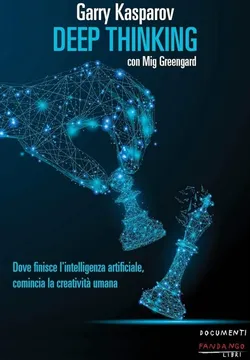
Deep Thinking
Author: Garry Kasparov
Publisher: PublicAffairs
Written by Garry Kasparov, this book examines his historic encounters against IBM’s supercomputer, Deep Blue. Kasparov reflects on his experiences during the crucial games, exploring the reasons for his defeat and the implications of human-computer interaction.
Further Reading (2/5)
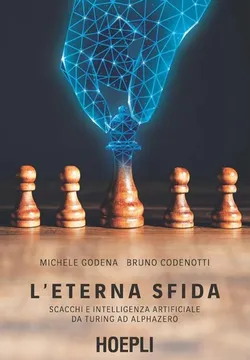
The Eternal Challenge
Authors: Michele Godena, Bruno Codenotti
Publisher: Hoepli
M. Godena and B. Codenotti guide us on a unique journey through history, science, and technology, showing how chess programming and the computer revolution have walked hand in hand. The book explores figures like Turing, Shannon, and McCarthy, who laid the foundations for the automation of chess thinking and traces the evolution of chess software from the 1960s to AlphaZero.
Further Reading (3/5)
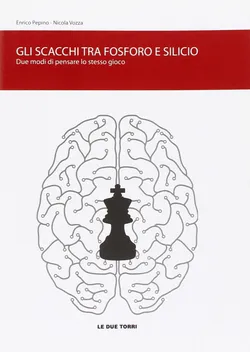
Chess Between Phosphorus and Silicon
Authors: Enrico Pepino, Nicola Vozza
Publisher: Le Due Torri
Published in 2010, this book analyzes the relationship between human intuition and artificial calculation, examining played games and comparing them with evaluations proposed by engines. The authors highlight how humans make decisions, emphasizing the differences from the cold and objective analysis of the era’s software, based on brute-force calculation. A fascinating journey between creativity and computational precision.
Further Reading (4/5)
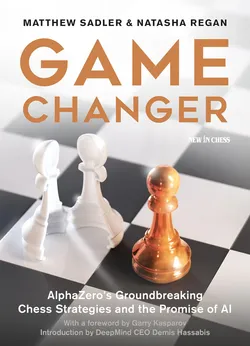
Game Changer
Authors: Matthew Sadler, Natasha Regan
Publisher: New In Chess
Game Changer tells how AlphaZero redefined chess principles through a creative and unconventional approach. The book offers a collection of games, analyses, and reflections on AlphaZero’s impact on the modern game. It’s a guide for those who want to explore the combination of artificial intelligence and creativity, showing how AlphaZero’s ideas have inspired new strategies in positional and tactical play.
Further Reading (5/5)

The Silicon Road to Chess Improvement
Author: Matthew Sadler
Publisher: New In Chess
The book offers tools to expand strategic repertoire and deepen middlegame understanding, providing clear models for typical positions. It helps use analysis engines more effectively, explaining suggestions in accessible terms. Additionally, it offers insights into high-level play, making strategies and tactics adopted by grandmasters comprehensible.